History of a hell hole
Part 1: The first descent

What would compel you to spend a night in a subterranean cave? Money? The spirit of adventure? Devilish susurrations in your ear (desssscend, my ssssweet, dessscend)? For two cavers, it wasn’t a matter of choice so much as necessity.
On the 16th of August this year, a couple of unlucky explorers became stuck down Eldon Hole, the deepest natural pothole in Derbyshire. Sixty metres below the surface, they waited for the Derbyshire Cave Rescue Organisation to come to their aid, no doubt envying their companions who had made it to the surface unassisted. The rescue mission was successfully completed by 3am on Sunday 17th. Newspapers reported that they were in ‘good spirits,’ which is perhaps surprising, given that Eldon Hole has long been associated with hell and heinous crime.
The murder that supposedly took place on Eldon Hill, and later accounts of cave exploration down in the depths of the hole, are fascinating topics that deserve their own posts. I’ve even written a folk horror book inspired by the area, which I’m currently querying.
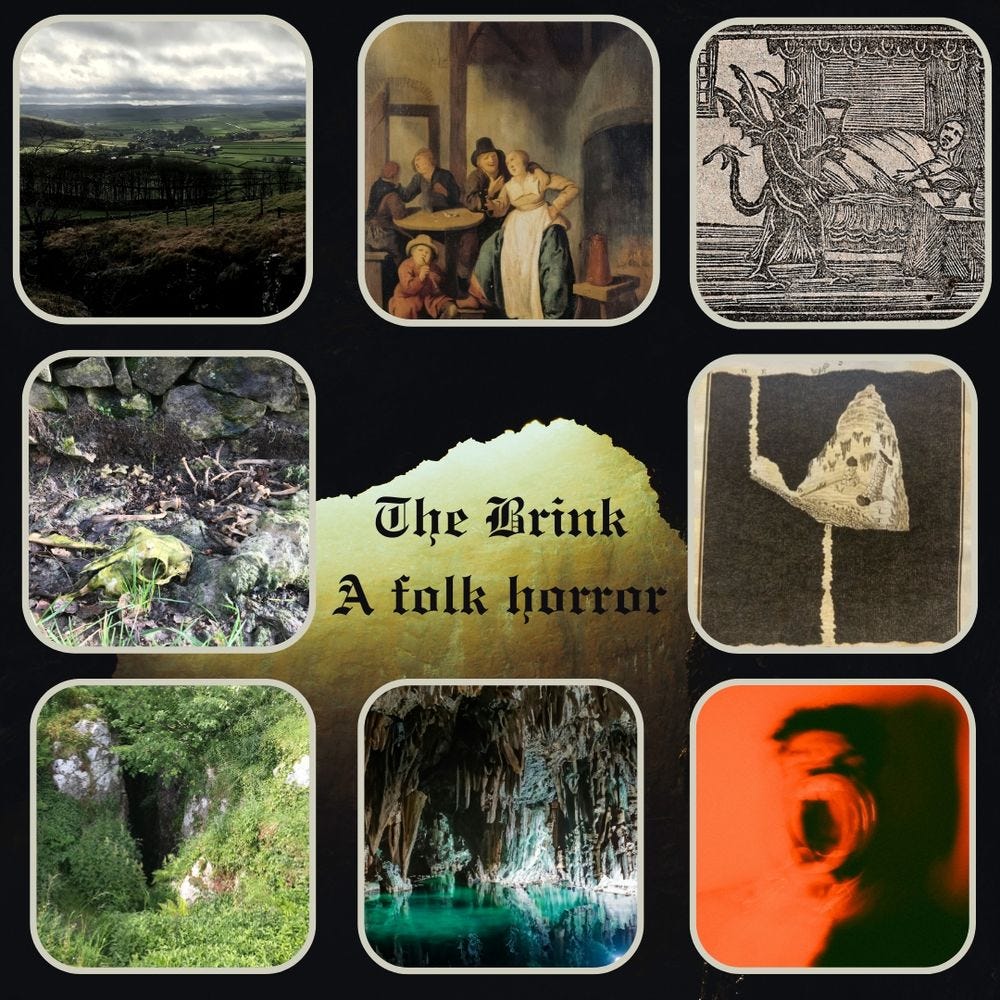
This article, therefore, will focus only on the earliest known descent.
Until the eighteenth century, the chasm was believed to be bottomless. It’s easy to see why. The rocky sides are steep; one would have to lean right over the edge to get a good look down the ‘throat’ of the beast, and even then, plant life and ledges of rock obscure the view. To test the hole’s depth, curious visitors to this natural wonder used to throw rocks down the chasm and count how long it took before a crash came ricochetting up. Counts varied, and some people could not hear the rocks hitting the bottom, leading them to assume that the sheer drop did not, perhaps, end at all.
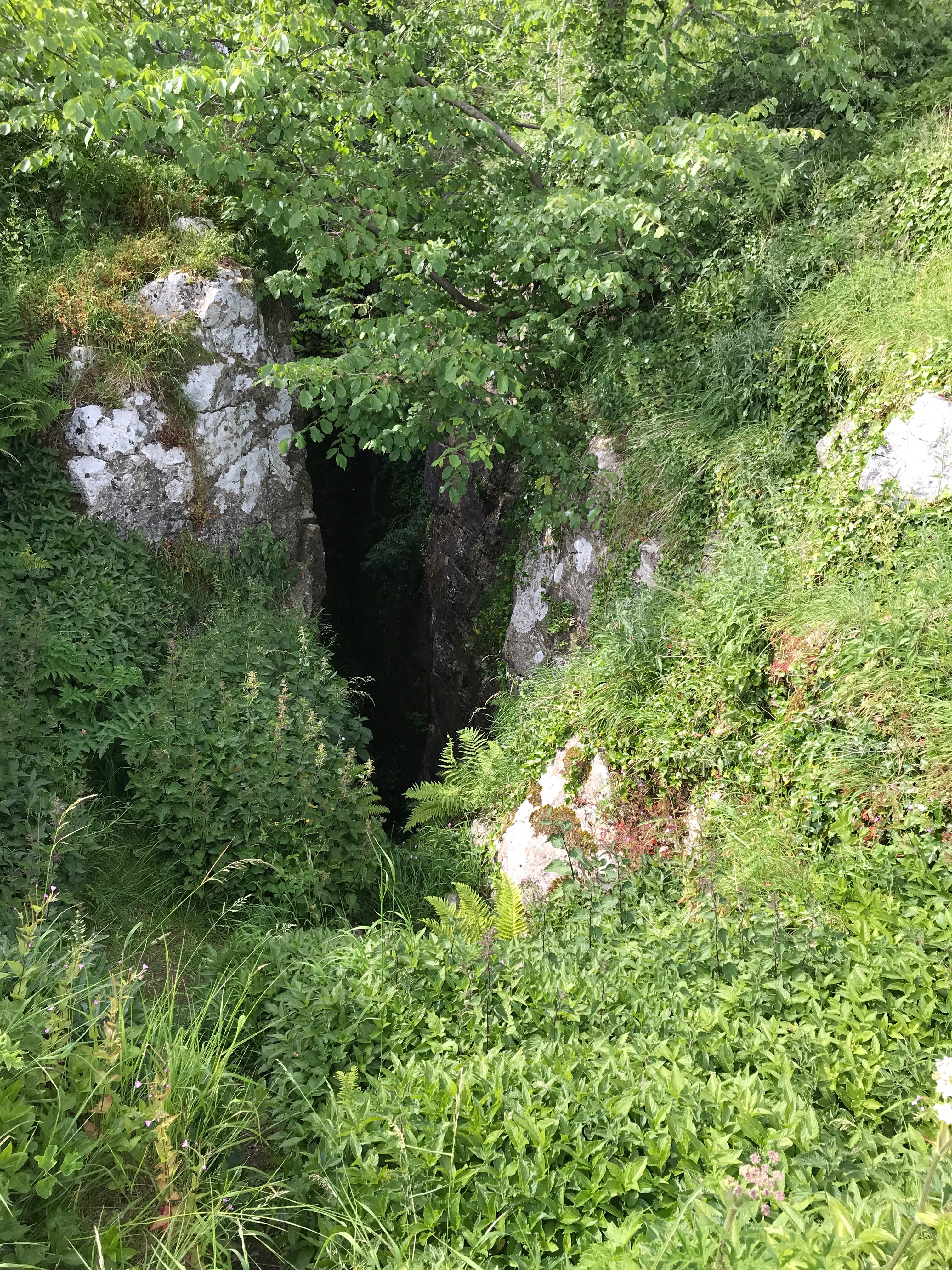
The first known evidence we have of a brave soul attempting to plumb the depths comes from Edward Leigh’s England described: or The several counties & shires thereof briefly handled (1659). Leigh recounts how ‘sixty years ago [1599] Mr Henry Cavendish […] caused Engines to be made for to let a man into the Hole, which being done, one George Bradley of the Peak Forest was let down in a rope fourscore yards [80 yards, or 73 metres].’ Two more ‘engines’ where made, which allowed Bradley to descend almost 240 yards. When he was brought back up to the surface
he was much affrighted, remained speechlesse for a time, and was struck with lamenesse; but after he recovered his speech, he declared, that as he descended down, were bones of Deer, Sheep, and other Cattel, and also of men, and that he was affrighted, but how, or in what manner he could not tell; he lived several years, but never was in perfect memory, nor sound of his limbs.
It is reasonable to assume that poor George Bradley was simply traumatised by the experience of being tied up and lowered into a dark hole with very little explanation of what to expect. Perhaps a modern medic may diagnose a stroke. But this was the sixteenth century, and demons roosted in lonely places, seducing or tormenting the souls of the living.
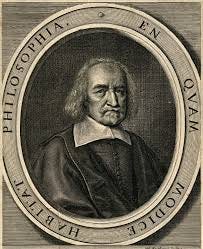
The source of Bradley’s fear proved intriguing to Thomas Hobbes of Leviathan fame. In his younger years, Hobbes lived at Chatsworth House and worked as private tutor to William Cavendish, second earl of Devonshire. In 1627, he travelled with his charge to visit the most famous sites of the Peak District, including Eldon Hole, writing of his travels in the Latin hexameter poem De mirabilibus Pecci in 1636. Hobbes was suitably impressed by the ‘dire hiatus’ with ‘forma cunnoeides’ (I’ll let you guess what that means). The text describes the journey of a stone as it travels all the way through the ‘infernal spheres’ underground: the Limbo of the Patriarchs, Purgatory, the Limbo of the Unbaptised, and finally Hell (‘infanda Tartara’), where we find virtuous pagans on the top level. He also retells the story of George Bradley’s descent.
Now, it wouldn’t do for Sir Henry Cavendish to be the instigator of such an unethical piece of geological research, as Sir Henry was young William’s uncle. In Hobbes’s version of the story, therefore, it is Robert Dudley, Earl of Leicester, who requested that a peasant be let down into the hole to test the depths for a ‘petty price.’ The resident of Peak Forest, unnamed in this retelling, only gets about 100 yards down before asking to be drawn up. Hobbes picks up on Leigh’s line, ‘he was affrighted, but how, or in what manner he could not tell,’ weaving it into an episode of Uncanny for the pre-Enlightenment era, with a rational explanation given alongside a supernatural one:
whether fear
Immoderate distracted him, or ‘twere
From the swift motion as the rope might wreath,
Or spectrums from his fear, or hell beneath
Frightened the wretch, or his soul’s citadel
Were stormed or taken by some imp of hell,
For certain ‘twas he raved; this his wild eyes
And paleness, trembling, all things verifies.
While Hobbes ultimately falls back on what can be observed (‘For certain ‘twas he raved’) and leaves several possible explanations open, the repetition of ‘hell’ after the more rational theories, along with his earlier poetic description of the levels of the underworld, leaves an enduring impression of malevolence, a sense that something demonic lurks beneath the earth.
The next poet to add to the legend of Eldon Hole was Charles Cotton.
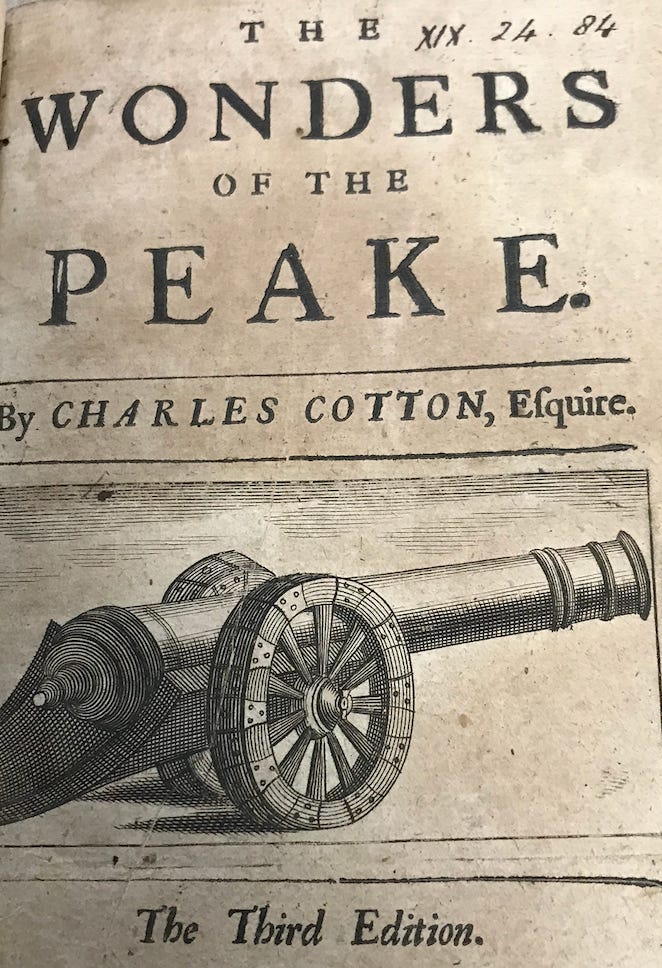
In 1681, cashing in on Thomas Hobbes’s infamy, he wrote his own version of The Wonders of the Peak, describing the edge of Eldon Hole as ‘the Brink of Hell’ and furnishing his account with ‘ridic’lous tales’ of mysterious goings-on in and around the chasm. His dismissive attitude towards local folklore reveals his prejudice. Indeed, one of the only stories he believes is based on his reading of Hobbes, a known authority.
But with these idle fables feign’d of old,
Some modern truths, and sad ones too are told:
One of that mercenary fool expos’d
His life for gold, t’explore what lies enclose’d
In this obscure vacuity, and tell
Of stranger sights than Theseus saw in Hell:
But the poor wretch paid for his thirst of gain:
For being cran’d up with distemper’d brain,
A fault’ring tongue, and a wild staring look
(whether by damps not known, or horror struck)
Now this man was confederate with mischance
Gainst his own Life, his whole inheritance
Removing any culpability from the nobility, Cotton turns the unnamed peasant’s descent into a cautionary tale of greed and an abundance of curiosity, not to mention a little pride, since he wants to ‘tell / Of stranger sights than Theseus saw in Hell.’ His ‘staring look’ and ‘fault’ring tongue’ seem a punishment for his presumption, affecting the very organs that led him to explore. Yet Cotton keeps his explanation secular and scientific, blaming the ‘distemper’d brain’ on miasma (‘damps not known’) or shock (‘horror struck’), embodying the rationalism the late seventeenth century has become known for.
Cotton’s greatest contribution to the legends of Eldon Hole is his tale of a murder which apparently took place there. Keep an eye out for a second blog post about this dastardly deed. In the meantime, stay out of infernal crevices, especially if a passing noble takes an interest (easier for some than for others, I suppose).
Loved the story. I'm attracted to caves anyway my first novel will attest to that.
Anyway, I can't wait to hear about the murder!
Your post has been selected as a candidate for the Ernie Award.The award is made monthly for the best article/story/post for the month.The only rules are: 1. Must be an original work (not created by AI) 2. Tasteful AI graphics are allowed. 3. No inappropriate, graphic, sexual references. 4. Writer must be at least a free subscriber to TexasErnieLee.Substack.com.
5.The Award recipient receives a $50 award.
Congratulations, the award will be announced on or soon after September 1st.
Looking forward to hearing about the murder! Sounds like such a strange place...